I chose this topic as it was something that heavily impacted me at the start of the session, pre-COVID. Unfortunately, the topic did become slightly less relevant as we transitioned to online uni, and I think it would’ve been more interesting to conduct my research in a normal session of uni. However, I felt as though the topic was still relevant as it is something that all university students at UOW had experienced at least once.
The results I received in my research definitely met my previous assumptions of people’s views on the current tutorial enrolment process at UOW, but the extent of how much it affected some student’s really surprised me. I hope it’s something the university can take into consideration for future sessions, particularly when we go back to face-to-face learning.
BCM212 was probably the best out of all my subjects to transition online, which made completing my research project much easier. The tutors, lecturer and fellow students were all so helpful and understanding of the difficulty of navigating online uni. The green book and reflective learning in tutorials also really helped throughout the session.
In terms of my research project itself, I definitely fell into the trap of procrastination, like I had listed in my risk matrix. My workplace reopening and sport restarting also impacted the time and focus I had to work on it.
Something I really liked about this subject and assignment was that it showed me different methods of collecting data, and doing it in an ethical and effective way. These are methods I can now use in future assignments, or in jobs I may have. It has also made me more aware of how I would answer in a survey/questionnaire or an interview, and what kind of information and answers are useful to a researcher.
Whilst there are many factors that differentiate each individual student experience, particularly at the University of Wollongong, there is one thing that almost all students can relate on. The tutorial enrolment process.
When discussing this with friends who are undertaking various degrees at UOW, as well as friends who attend other universities across the country, I became aware of just how big of an impact the current tutorial enrolment process at UOW has on students. I wanted to study this topic for my BCM212 research project to investigate student’s true thoughts on the process and to see if there were ways it could be improved to suit their needs.
To gain a deeper understanding of this topic, I conducted two online surveys where I acquired quantitative and qualitative data. I then undertook research of secondary sources to support the findings from my surveys.
There were some limitations I experienced throughout my research into the tutorial enrolment process. Due to the relatively small sample size of 51 participants across my surveys, and the fact that they are all Communications and Media students at UOW, my results may hold a bias and may not reflect the views of the entire student body of UOW. The fact that this particular aspect of the student experience was mostly only relevant to the University of Wollongong, I was also limited in secondary sources to analyse as part of my research.
RESULTS
How do students feel about the current tutorial enrolment process at UOW?
I posed the question, “How would you describe your feelings towards the current tutorial enrolment process at UOW?”, to the 44 participants who participated in my first survey posted to Twitter and promoted through the #bcm212 hashtag.
63.6% of participants responded with various answers that used the word “stressful”. Multiple participants also stated it was “anxiety-inducing”. Only 2 participants expressed that they had no issues with the current process. There were varying answers to this that included:
“I think the first in best dressed system is really fair and effective. As long as you have access to capable internet.”
“STRESSFUL AF, literally na [put in unavailability] for work the day that I know I have enrolments because I stress all day about not getting the times I need.”
“It’s easy when you’re in high school like they tell you exactly what to do with the atars and uac process but after you’ve accepted your offer they sort of leave it up to you. The timetable system is tricky to work out and frustrating. It definitely helps if you have older siblings or friends who have previously enrolled- if I didn’t I would feel pretty lost.”
These answers somewhat confirmed my preexisting belief that some UOW students struggled with the current tutorial enrolment process.
The Impacts of Tutorial Enrolments
For a majority of students, university is not their only priority or commitment. In recent years, university students have identified they struggle to balance study, family, financial hardship and paid work that has in turn impacted their daily lives, study success and mental health (Gair, 2018).
When students are unable to create a university timetable that suits the other factors of their life, it can only add to this stress. This struggle was also highlighted in one of my survey questions I asked participants:
Work was highlighted as something that was impacted the most by tutorial enrolments and timetabling. According to a study conducting by Dr Michelle Hood, 80% of university students studying full time have paid employment, with 40% of these students working 16 or more hours a week (Griffith News, 2018).
Survey participants were asked to expand on the aspects of life that were impacted by missing out on their required/desired tutorial times. Some answers included:
“As I am doing a Cadetship, it was important to line my timetable up with my work schedule as I only get a certain amount of hours each week dedicated to uni work.”
“Required me to sleep on mates couch bc of late times.”
“Had to change my work hours I’d been doing for over a year with the same company, had to miss out on one of two training sessions a week for footy.”
“it also impacts flow of my life – wasting time waiting around for the next class, have to go in to uni for just 2 hours, wastes time travelling, disrupts my study and reduces the time i have to relax.”
I found some of these answers relatable to my own experience as a student struggling to juggle my work and other commitments when I only managed to get 1 of my preferred tutorial times. Some were alarming to me, especially the fact that a participant had to stay the night at their friend’s house due to the late time of their tutorial.
The University Of Sydney’s Tutorial Enrolment Process
I conducted a second, smaller survey where 7 participants were given a comparison of the University of Wollongong and the University of Sydney’s tutorial enrolment processes and asked to answer questions about this comparison.
Out of the 7 participants for this survey, 6 identified that they did not like the current tutorial enrolment process in place at the University of Wollongong, and 1 identified that they were “50/50” on the process.
The University of Sydney describe their tutorial enrolment process as a system which “prioritises minimising clashes and keeping class numbers balanced, then student preferences are taken into consideration” (University of Sydney, 2020). USyd also use a system to create students timetables instead of student’s manually creating their timetable, like UOW.
USyd Tutorial Enrolment Process 2020
All 7 participants stated that they preferred the University of Sydney’s tutorial enrolment process over the University of Wollongong. Elaborating on this, themes such as “accomodating for student’s needs”, “allowing more time for organisation prior to the semester”, and “less stress” justified their answers.
Recommendations
Across both of my surveys, I asked participants for suggestions on how the University of Wollongong could improve the current tutorial enrolment process. Some of these suggestions included:
“Have them do enrolments earlier than two weeks before uni starts. So I can plan tutorial swaps earlier is needed.”
“Getting each student to fill out their preferred times before enrolment opens, then if one class has too many students it shows up as red, then students have time to re-evaluate one’s schedule if they can’t get into that particular class.”
“Expressions of interest by students, nominating the popular days and times.”
“potentially be more understanding towards students, set up a system where students can easily swap tutorial times.”
“….The process of first in best dressed is unfair and can be very stressful for students when trying to sort out their timetables, so getting rid of that would definitely make students feel more comfortable and feel like their needs matter to the uni.”
“Make it more flexible and catered for modern uni students. Most people have lots of other factors to consider outside of uni.”
It is clear from my research, that if available, a new system or some changes to the current tutorial enrolment process would be welcomed by current students, and may also benefit new students to the University of Wollongong.
How does not getting your desired tutorial times impact on the other aspects of an individual’s life?
Every university student has a different student experience, and for many students, including myself, this includes balancing work, sport, extracurricular activities, family, relationships and socialising with university.
It can be hard to create a university timetable around all these commitments, especially with the tutorial enrolment process that UOW has currently put in place for students. It can be especially hard to accomodate for every student’s needs in subjects with large cohorts with enrolment into desired tutorial times being determined by how fast you can refresh a webpage and select a time slot.
Whilst I was unable to find current or past studies into “not getting the uni tutorial enrolments you want”, the polls I conducted on Twitter for this research proposal gave me an insight into how this aspect of the student experience may impact on an individual’s life.
Although 35 students is a small sample size, this poll gave me an insight into the high number of students who were unable to get a space in their preferred or required tutorial times.
This poll also confirmed my belief that not getting the tutorial times you prefer or require impacts on an individual’s life outside of university.
According to Susan Gair, the ability to balance university, work and other commitments has only become more difficult in recent years. University students have identified they struggle to balance study, family, financial hardship and paid work that has in turn impacted their daily lives, study success and mental health (Gair, 2018). Nearly 80% of university students studying full time have paid employment, and according to a study by Dr Michelle Hood, 40% of these students work 16 or more hours a week (Griffith News, 2018). Being unable to enrol in your required tutorial times can only contribute to the stress of maintaining a uni, work and life balance.
This is something I unfortunately experienced at the beginning of this session (pre COVID-19). Regardless of the lists and multiple perfect draft timetables I’d created, like suggested in this Year 13 article, I was unable to find a place in my preferred tutorial times and only managed to get 1/4 of my preferences. This meant I had to travel to uni four days a week, instead of my preferred two days. This had a major impact on my weekly schedule as I had factors such as a 1 hour train and bus commute to and from university, a job to support myself, netball training and coaching a netball team to consider. I’m sure this is also the reality for hundreds of other UOW students too.
Is there a better tutorial enrolment process that can lessen the impacts?
Complaining about tutorial enrolments seems to be a universal topic for all UOW students, and is something anyone studying any degree can agree on. I wanted to research other university’s enrolment processes to see if they were similar or dissimilar to UOW, as I had never heard my friends, who attend universities such as USyd, UTS and UON complain about their tutorial enrolment process.
This process seemed to reduce the stress and uncertainty of tutorial enrolments felt by UOW students. It also seemed to be more inclusive for students who may be juggling many other priorities in their lives such as family, work, health and sport. Looking into this process also definitely made me curious to research this further in within the project and to find ways that UOW could possibly improve their own tutorial enrolment process.
Is this timely, achievable and relevant?
I believe researching this topic will be timely and achievable as it is a universal experience for UOW students and is definitely something I would be able to get a lot of feedback and varying answers on from students and staff within this degree, as well as outside this degree if necessary. It is also relevant as whilst the current situation the world is in has impacted our ability to attend university physically, it is something that has impacted the majority of students at UOW in recent years and the beginning of this session.
No two student experiences are alike. Factors such as degree, culture, gender, living on or off campus, nationality, health, work and extra curricular activities all come together to create your own unique student experience.
For BCM212, we are focusing on the student experience and what makes us different or the same. The aim of our main project is to find our “curiosity” about the student experience and research it.
My curiosity is tutorial enrolments.
Specifically, I’d like to focus on how the process of tutorial enrolments impacts on a student’s life outside of uni.
I really wanted to focus on this topic as it is something that has greatly affected my life outside of uni this session. I was very lucky last year in getting all (or close to) all the tutorial times I needed to balance my work, sport, family and social aspects of life. This session I was not as lucky. Due to clashing tutorial and lecture times, subjects on different campuses, and a laptop that decided to stop working exactly 1 minute before tutorial enrolments went live, I have been left with a very inconvenient schedule.
As a student who also has to commute just over an hour via public transport, I also understand the struggle of students who commute to uni and how not getting their preferred tutorial times can have a flow on effect into other aspects of their lives.
Did you get the timetable you wanted this session? Has not getting the tutorial times you wanted impacted on your life outside of uni?
Unfortunately, due to work and other uni commitments, Astrology Lane took a hit due to our inactivity. In the final week of BCM114 however, we have introduced new content on our Instagram, and kept up our presence on Spotify and Twitter.
Instagram:
We continued to develop our new aesthetic. We have found issues along the way with appropriate colour choices for our photo text but have continued to adapt.
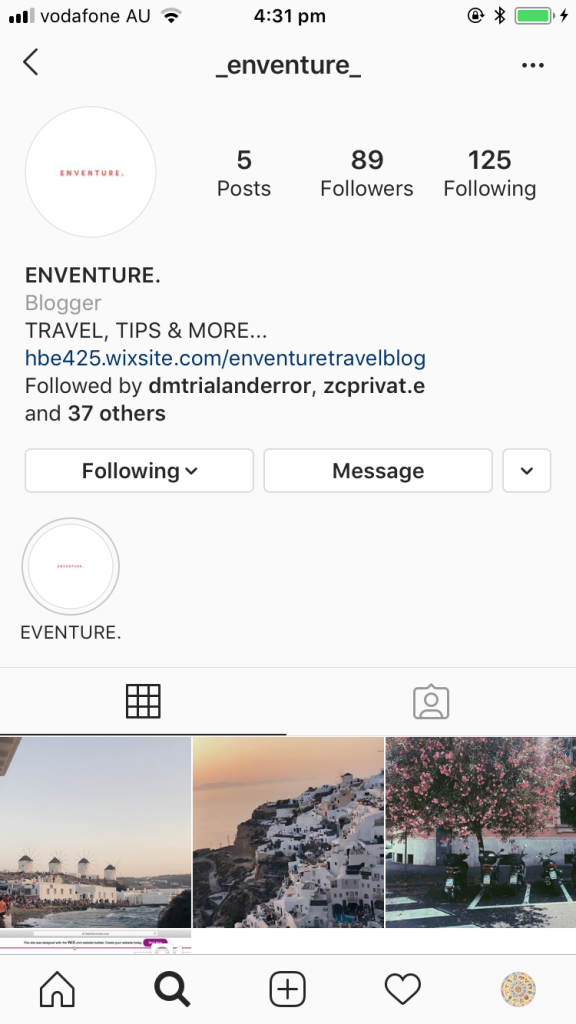
We created a collaboration with Heidi and Annagh at Enventure. We made a holiday destination post for the zodiac signs based on locations the girls had written about.
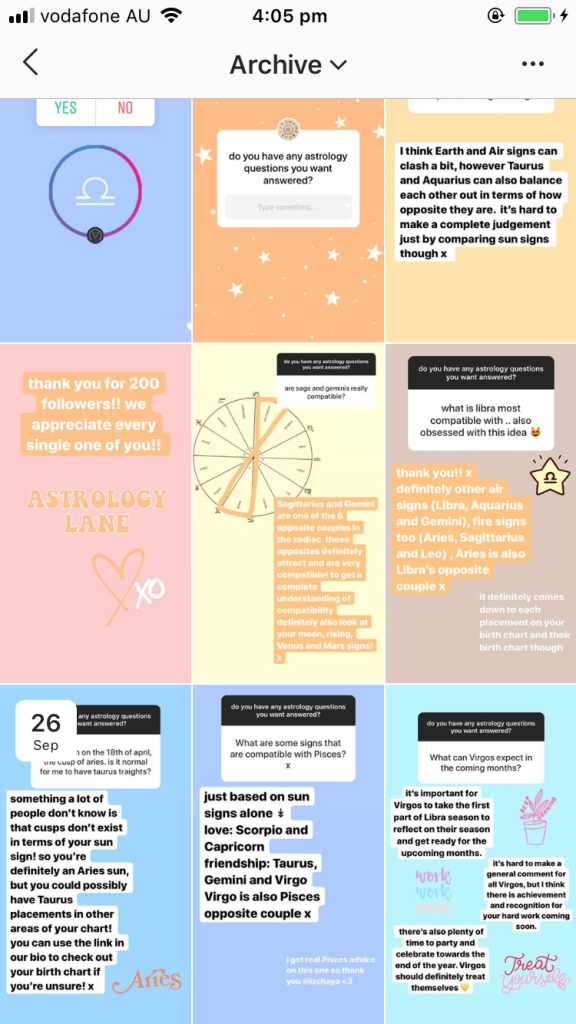
We tested new concepts on our story. We had asked followers “what would you like to know about astrology?”. This gained little response. We created a new series on our story where we posted zodiac quizzes, which were a success.
Spotify:
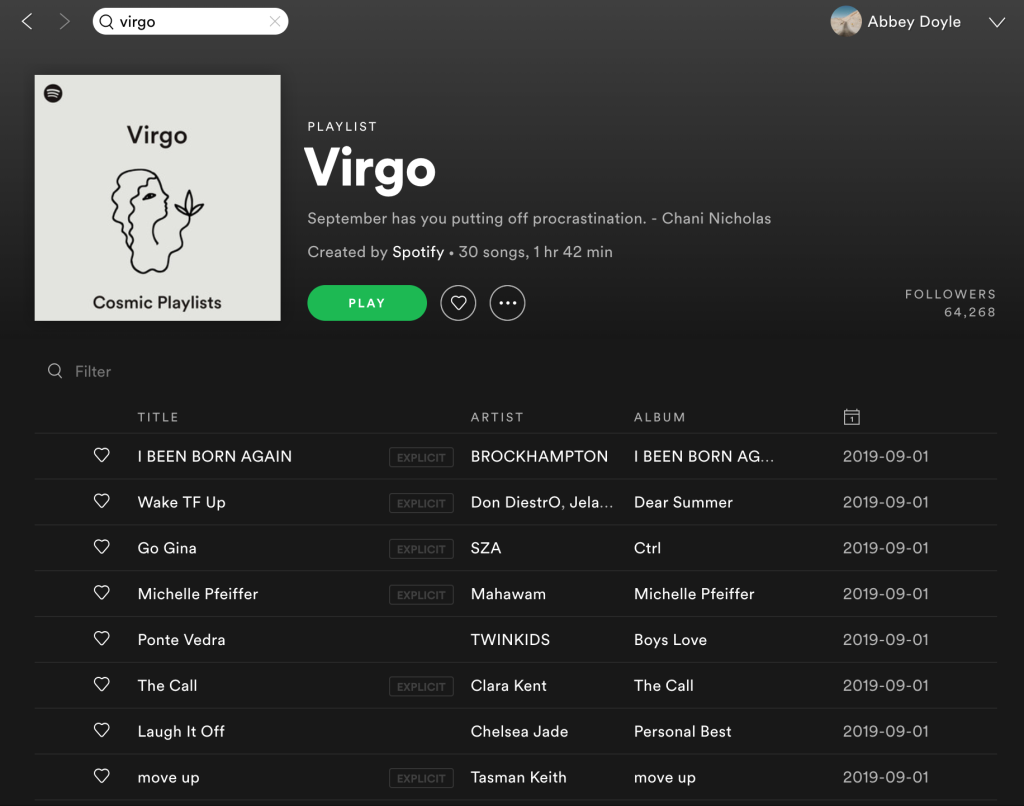
As Spotify offers no insight tools it is hard to gauge the success of our zodiac playlists. I have received some comments from friends and family however who really enjoy their sign’s playlist.
Twitter:
We became more active on Twitter through the last module of our DA. We engaged with our followers, promoted our Instagram content and retweeted relevant zodiac content from other accounts.
Progress on our DA has definitely slowed since working on our Beta assignment, however we have made lots of great changes to Astrology Lane throughout the prototyping stage.
INSTAGRAM
Instagram is where most of Astrology Lane’s content is based.
During the prototyping stage we have made the following changes:
new aesthetic. We moved on from our earthy tones and have decided on a more pleasing pastel palette.
new series. We have created a new series of posts using information from our blog, which we have decided to discontinue due to poor engagement.
engaging with followers. We have done this through creating discussion in the comments of our posts as well as asking questions on our story.
collaboration. We worked with Lucy at Into Our Garden and created Instagram posts for both of our accounts about plants and astrology.
SPOTIFY
Our Spotify playlists were posted during the prototyping stage. This was in an attempt to expand our DA as well as create astrology content on a non-traditional social media site. We have received positive feedback from followers and other BCM114 students and tutors about these playlists and hope to continue to develop these through the next phase of our DA.
The only issue with our playlists was that Spotify also released similar playlists just after ours were posted. This was a bit disheartening due to the attention they received.
TWITTER
We created a Twitter account for Astrology Lane around the time our Beta was due. We hoped to use this platform to connect with a new community of followers, as well as post content that was different from our Instagram, such as memes. This has remained fairly inactive since creation, so we hope to begin posting on there soon.
WORDPRESS
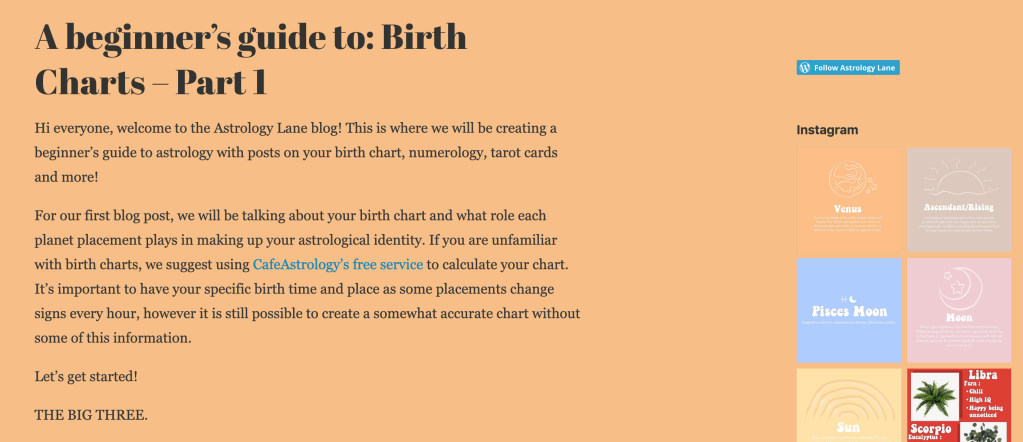
During the prototyping stage we realised that our WordPress blog was not attracting a lot of attention, despite posting content our followers had asked for. We have decided to discontinue the blog. To not waste the work we put into it, we have used the information we posted to create a new series on our Instagram.
FUTURE…
We still currently have stickers and prints in the works and hope to release these in the near future. We have tried to work on ways to make these items affordable and accessible to everyone, and have been trying to follow the FIST ideology closely.
We have the opportunity to expand to other platforms such as Tumblr and Pinterest.
IGTV is something we are definitely interested in making content for.
We have plans to create more collaborations with other DAs such as Baking Bad and Enventure.
We decided to create Astrology Lane as our digital artefact as we all had an interest in astrology and wanted to share aesthetic but educational content in an accessible way.
We originally planned to post on Instagram, Spotify and WordPress. We have decided through ideating and prototyping our DA to drop our WordPress page, and have also established a Twitter account.
INSTAGRAM
Instagram is where 95% of our digital artefact happens. We have been posting different “series” of educational content.
We utilise Instagram stories frequently, posting polls and asking questions for our followers. As I write this blogpost we are currently answering questions people have asked after posting “Do you have any astrology questions you want answered?”.
Instagram is also a great platform as the insights tool is really useful to gain an understanding of followers needs and wants without them actually being verbalised. It allows us to see what types of posts and stories are successful, and if people are engaging with our other content through the link in our bio.
We have also expanded our DA by collaborating with fellow BCM students and their DAs. We posted a collaboration with Lucy and her DA Into Our Garden. We also are planning to work with Nikita and Rebecca at Baking Bad, and Heidi and Annagh at Enventure.
SPOTIFY
We posted playlists for each of the 12 zodiac signs which featured artists of the particular sign.
We promoted these on the Astrology Lane Instagram as well as our personal Twitter accounts. Whilst Spotify does not have any insight tools as it is not a traditional social media sight, we received positive feedback from our followers, as well as other students and tutors.
Something that may have drawn attention away from our playlists is that Spotify also released zodiac inspired playlists just after us. We understand however that plenty of other playlists similar to ours exist, it was just a coincidence in timing.
WORDPRESS
We posted a blogpost on WordPress that went into more detail on astrology. We originally planned to do this as we knew that it would be harder to engage an audience on Instagram with information in higher volumes. A poll on Instagram gave us an insight into what our followers wanted to learn and we took this on board.
Our blog post did not receive much attention, and we realised that even though people wanted the content, they wanted it in a more easily accessible way. To adapt to this, we decided to create a new series on our instagram where we use the information from the blogpost to make Instagram posts using Adobe Illustrator.
FUTURE PLANS
We have just created a Twitter account for Astrology Lane to help promote our current content as well as post on Twitter to tap into the large “astrology Twitter” audience.
We are also working on ways to monetise our DA. We are currently designing prints and stickers that we can post on Etsy and/or Redbubble. We are trying to make this as cost effective and affordable for us, as well as customers, to stick to the FIST concept.
Mid90s is a 2018 film directed by Jonah Hill, and is based around a 13-year-old boy named Stevie growing up in Los Angeles in the 1990s with his mum, Dabney and older brother, Ian, who is abusive towards him. The film follows his journey as he becomes friends with some older guys, Ray, Fuckshit, Ruben and Fourth Grade, who are skaters.
Ray, Fuckshit, Ruben, Fourth Grade and Stevie aka “Sunburn”
I personally thoroughly enjoyed the film. I really liked the aesthetics of the film and it made me feel somewhat nostalgic for a decade I never experienced. I also liked the laidback storyline, it felt almost as though I was watching a documentary or just observing someone’s life. As a teen girl, I think I was definitely apart of the intended audience of this coming-of-age story, as well as those who would have actually lived through the skate culture of the 1990s and for those interested in skating now.
To be able understand and enjoy this film, I think you need to have a knowledge of skate films and their specific style. Throughout the film, Fourth Grade is filming everything, from skating, to chats with some homeless men, and this all comes full circle at the end of the film when *somewhat spoiler alert* he shows all the boys a short film he has made called ‘Mid90s’.
One of the co-producers of the film, Mikey Alfred, is the founder of a Los Angeles based skateboarding and clothing brand, Illegal Civilization, who also produce music videos, short films and documentaries. As a fan of the content this brand creates, their influence is really felt through the style of the film. Many of the actors in the film are skaters in real life and are heavily involved with the brand. Most of them had no prior acting experience to this film and I think this is what also gave Mid90s such an authentic vibe.
Mid90s is an example of a homogenised film. It was produced in Los Angeles, the home of Hollywood. It has travelled around the world, and received nominations for awards in other countries, such as a nomination for ‘Best Feature Film’ in the Berlin International Film Festival. It centres around a subculture of skating that is local to the Los Angeles area, however was, and is found, all around the USA and other countries, mainly in Western society.
Toxic Masculinity and Skate Culture
Toxic masculinity is a manifestation of masculinities that is characterised by the enforcement of restrictions in behaviour based on gender roles that serves to reinforce existing power structures that favour the dominance of men (Parent, Gobble, Rochlen, 2018). It is typically characterised by a drive to dominate and by endorsement of misogynistic and homophobic views.
Jonah Hill wrote and directed Mid90s based loosely on his own experience growing up in LA as a skater in the 90s. As someone who had a limited knowledge of skate culture prior to watching Mid90s, I did notice and was somewhat shocked at the intense toxic masculinity that plagued some of the characters in the film. This is something that Jonah Hill actually wanted to emphasise in the film.
“I grew up in a skate culture in the mid-’90s, and within the film there is strong language—homophobia, misogyny, and avoiding intimacy at all costs. That was taught, and I wanted to show those things explicitly and honestly, to show the lessons we as a culture had to unlearn. To me, yeah, there is a real toxic masculinity to any time you’re about to feel something or connect.”
“Cultural appropriation is the unacknowledged or inappropriate adoption of the customs, practices, ideas, etc. of one people or society by members of another and typically more dominant people or society.”
Oxford Dictionary
Hip-Hop
Hip-hop, or rap, culture originated in the South Bronx of New York City in the 1970s. Hip-hop music developed as part of the culture. It is is defined by four key stylistic elements: rapping, DJing/scratching, sampling and beatboxing (RapWorld, 2019). Hip hop is heavily influenced by African music, specifically the griots of West Africa, and today is typically associated with African American culture.
With the genre’s roots so heavily influenced by black cultures, hip hop has been a way for black people to be able to express themselves and create music about issues affecting their community such as racism and police brutality. A perfect example of this is N.W.A, a popular rap group in the 1980s and 1990s who used their platform to speak out about issues facing the black people of America, particularly in Compton, a city in Los Angeles, California.
The Cultural Appropriation of Hip-Hop and Black Culture
“I argue that colourblind ideology provides whites with the discursive resources to justify their presence in the scene, and more important, to appropriate hip-hop by removing the racially coded meanings embedded in the music and replacing them with colour-blind ones.”
It is evident through the appropriation by non-black people of themes typically associated with hip-hop culture and music that there is an element, conscious or subconscious, of a colour-blind ideology and approach to implementing these themes in their music.
In recent years, performers like Iggy Azalea and Miley Cyrus have come under scrutiny for cultural appropriation. Azalea is an Australian rapper who is accused of using a ‘blaccent’ and has been heavily criticised for “profiting from a culture that is not her own” (SBS, 2016). After Cyrus’ 2013 MTV VMA’s performance featuring twerking, a dance move which originated in hip-hop culture, she was called out for cultural appropriation by hip-hop artists, Jay-Z and Azaelia Banks.
Japanese Hip-Hop
In the past decade, hip-hop has become more mainstream within the Japanese music scene. However, it seems as though popular Japanese hip-hop artists are not just appreciating the genre of hip-hop, but are borrowing from other cultures without acknowledging the history and heritage behind them (Tai, 2018).
“What most people do is excavate a musical genre or a fashion trend from very diversified people of distinct cultures … It’s an act that collapses the complexity the people, their history and cultures.”
In Japan, hip-hop artists and fans are taking their “appreciation” of black culture to the next level. Black skin, hairstyles and clothing have all been fetishised and become desirable and attractive “trends” for young Japanese people (Cornyetz, 1994). This style is known as ‘b-style’, which in most other countries, would be seen as blackface.
This is further encouraged by the appearance of popular Japanese artists, such as Skull, a reggae artist, who seems to “conduct himself like a caricature of how he thought black artists performed” (Tai, 2018).
Without educating yourself on cultural appropriation and how much it can impact on an individual and their community, you could be completely oblivious to cultural appropriation. Many people believe that cultural appropriation is actually a form of cultural appreciation, however, there are way less offensive ways to show your appreciation for a culture that is not your own.
As a society, we have become more sensitive to cultural appropriation and how and where it appears. The music industry appears to be a place where cultural appropriation is rampant, and has been for many years. However, by calling artists out when something they put out is a bit off or offensive, we can help educate others and put an end to the offensive practise of cultural appropriation.
In the second week (currently), there has been less growth as we have not posted. This has been a lesson in regular posting and its link to growth which has been particularly highlighted in recent readings and lectures in BCM114.
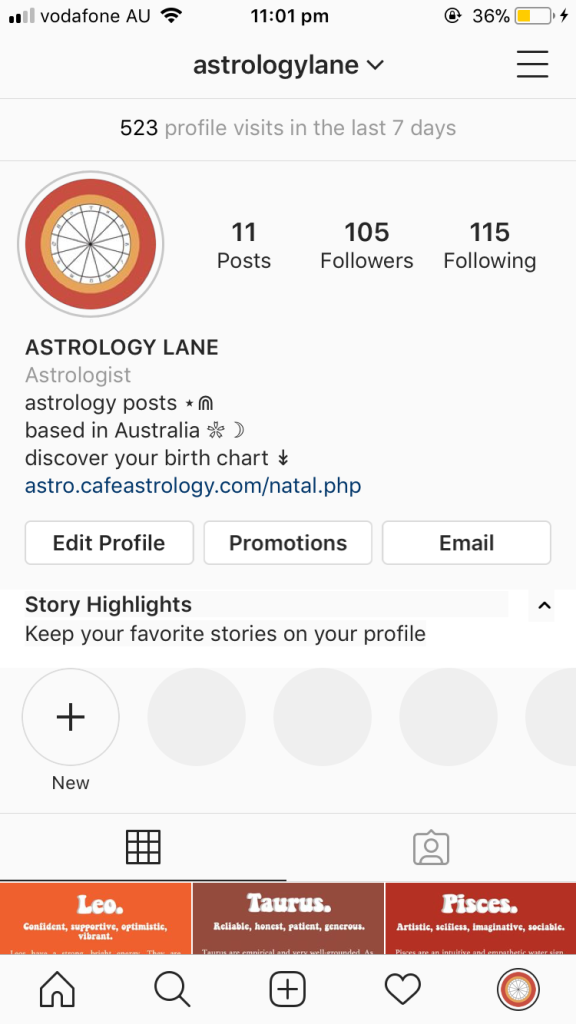
The account on 28th August
Interaction with the page was really great and we received positive feedback that stated our followers resonated with our posts, which was really encouraging. However, we are yet to receive any constructive feedback on ways to grow our DA.
We also noticed, through using the ‘Insights’ tool on Instagram, that our followers reflected the initial demographic we believed would engage the most with our content (13-30 year old women).
The Insights tool has been very useful as we are able to see how well posts are going in terms of how many people visited our page through that particular post, how many people saw it, how many times it was direct messaged to someone and how many people have saved it for future viewing.
Our two ‘best performing’ posts
We posted the first blog post to our WordPress account. We asked a question through Instagram Stories and tailored the post to answer topics that came up. It isn’t expected to gain much response as it is just in the beginning stages. We will continue to build on this and discover if it is worthwhile to continue.
We are in the process of creating the Spotify playlists as accompanying content to our Instagram content, and these will be published within the next week.
“You ideate by combining your conscious and unconscious mind, and rational thoughts with imagination”.
Hasso Plattner, An Introduction to Process Thinking
With the words of Hasso Plattner, Ted and our tutors on our minds, we have continued to ideate through the process of creating our digital artefact and have come up with further ideas to test in the future.
Please feel free to comment any feedback below and follow us! x










 abbbey.home.blog