Astrology Lane is a platform in which people can explore astrology on a deeper level than just their daily horoscope in a magazine. We have discovered that there is currently a large interest and demand for astrology-based content in the particular demographic of 13-30 year-old women. Our (me, Rachel Hopkins and Sophie Morris) content, which is all original writing and graphics by us will be originally posted on Instagram, Spotify and WordPress.
Instagram – this is where people can access basic information on astrology in an “aesthetic way”. We will also post frequent interactive Instagram stories including polls and Q&As. All posts will be original content.
An example of a post you will find on the Instagram
Spotify – we will be creating a playlist for each of the 12 zodiac signs which feature songs by artists of the specific sign, as well as songs that fit the common characteristics of the signs. These will be linked to all accounts under the Astrology Lane “brand”.
WordPress – weekly blogposts will discuss astrology in further depth and create a beginners guide to astrology. This blog will also feature discussion on other topics linked to astrology like tarot cards, numerology and birth charts.
Astrology Lane also has the potential to expand to Twitter, Tumblr, Youtube and Facebook accounts, which we will explore as we come up to the Beta prototype. An Etsy store could also be opened as astrology prints created by Instagram pages such as @Sistersvillage are quite popular.
I’m a massive consumer of global television thanks to streaming platforms, Stan and Netflix. Some of my favourites include Brooklyn Nine-Nine, The 100, Mindhunter, Downton Abbey, Jane The Virgin, The Office (USA), Community, and Parks and Rec, just to name a few.
As I’ve grown up, sitting down and actually watching television has become less and less common for me. You’ll only find me in front of the TV if there’s an NBA or NBL game or if Google Box or Survivor happen to be on.
However, there is one very special annual occasion that will always have me hooked to the TV for a solid few days….
Eurovision Week has been held in May annually since 1956. It is, in my opinion, up there with any special occasions like Christmas, Easter, New Year’s and my birthday. My whole family looks forward to the nights we spend watching Eurovision, the days avoiding spoilers due to timezones, and the weeks after of rewatching all our favourites and guilty pleasures. According to my dad, my parents started watching it in 1995, and my family have followed it ever since.
The Eurovision Song Contest was introduced by the European Broadcasting Union in the mid 1950’s as a way for a war-torn Europe to come together in the aftermath of war. In the first “Eurovision Grand Prix” held in 1956, only 7 countries performed: Belgium, France, Germany, Italy, Luxembourg, Netherlands and Switzerland. Since this humble beginning, Eurovision has grown majorly.
Switzerland won the first Eurovision Grand Prix with the song Refrain by Lys Assia.
As of 2019, 50 countries are eligible to perform in the song contest. This number is not limited to just European countries, making the competition global. Western Asian countries Israel, Cyprus and Armenia have been annual contestants since 1973, 1981 and 2006 respectively. Morocco also competed in 1980. The transcontinental countries of Turkey, Russia, Georgia and Azerbaijan also all annually compete.
One of the most surprising and recent inductees to the Eurovision Song Contest was Australia in 2015.
Eurovision’s Australian Success
Eurovision has been shown by the Special Broadcasting Service (SBS) in Australia since 1986, by broadcasting the BBC’s coverage which was accompanied by Terry Wogan’s ironic commentary (Highfield, Harrington and Bruns, 2013). Wogan retired in 2009 and since then, SBS have sent their own commentators to create their own broadcast of the show.
“Ironic engagement with Eurovision forms an important, if not as central, part of the commentary for SBS’s broadcasts – not just on air but also among the audience sharing their Eurovision-related thoughts on Twitter”.
Highfield, Harrington and Bruns – TWITTER AS A TECHNOLOGY FOR AUDIENCING AND FANDOM (2013)
In the Week 2 BCM111 lecture, we were asked to think about what we think is the reason for the global success (or failure) of our chosen topic. I believe that Eurovision’s cult following and success in Australia can be put down to the comedic approach of SBS’s commentary, as well as the social media commentary of those watching at home.
Whilst European viewers may view the competition with a more serious, competitive eye, Australian’s love the “kitsch spectacle” of the show and many watch with a “detached, ironic posture” (Skey, Kyriakidou, McCurdy, Uldam, 2016). This is highlighted through the #SBSEurovision hashtag used across Twitter, Instagram and Facebook. Here’s a collection of some of the tweets from this year’s Eurovision:
Further Global Influence
Eurovision has inspired people around the world to establish their own adaptions of the contest. The Caribbean Song Contest began in 1984 and the Asia Song Festival first aired in 2004. The Eurovision Asia Song Contest is set to be held on the Gold Coast later this year and will be produced by the European Broadcasting Union (EBU) and SBS. There has been some controversy around the contest however, as it was originally meant to occur in 2017.
A performance from the 2018 Asia Song Festival
Political Undertones
Eurovision wouldn’t be Eurovision without its slight undertones of European politics. You can count on the juries of Greece and Cyprus to give each other 12 points, Germany to receive very little votes (except in the case of Lena and ‘Satellite‘ in 2010), and for Russia and Israel to receive some boos from the crowd.
Political protests are usually stopped by Eurovision officials prior to Eurovision week, however the use of live television broadcasts can impact on this control. This year, Eurovision was hosted by Israel in Tel Aviv. During the counting of votes, the cameras panned to the Icelandic group, Hatari, who were waving Palestinian flags that read “Free Palestine”.
Thanks to the concept of global media and television, Eurovision is a way for countries around the world to come together through their love of music, good and bad, outrageous staging, stunts and costumes and a little friendly competition. I’m already counting down the days until next year!
For those of you who are new to Eurovision, here is a playlist of some of my favourites, and favourites to laugh at. Check out the Eurovision Youtube channel for some great content too. If you’re a fellow Eurovision fan, tweet me some of your favourite Eurovision moments!!
Fake news are false stories that appear to be news, spread on the internet or using other media, usually created to influence political views or as a joke (Cambridge Dictionary, 2019).
Fake news, whilst existing for centuries, has become a relevant topic in recent years. The 2016 US Presidential Election was a particular event which created thousands of fake news articles and sparked many debates on the topic.
The basics:What are the types of fake news?
Fake news can generally be reduced down to 5 categories:
Clickbait – This is a form of fake news that has developed since the invention of the internet. Clickbait generally takes on the form of exaggerated headlines, Youtube titles, etc. that will increase “clicks” and visitors to a website, video or social media post. This may also create extra revenue for a content creator.
Examples of clickbait Youtube titles and article headline
2. Propaganda – Propaganda is a systematic effort to manipulate other people’s beliefs, attitudes, or actions by means of symbols (words, gestures, banners, monuments, music, clothing, insignia, hairstyles, designs on coins and postage stamps, and so forth) (Britannica, 2019). Propaganda is generally linked with politics, however, it can created and used by anyone for any cause.
3. Satire/Parody – There are multiple websites and social media sites around the world that publish only “fake news” for entertainment purposes. In Australia, an example of this is The Betoota Advocate. Other examples include The Onion, an American site, and Waterford Whispers, an Irish site.
Two articles recently posted by The Betoota Advocate.
4. “Sloppy” Journalism – This is usually a mistake, either information used for an article has been incorrect, or a journalist has not conducted enough in depth research. This, in turn, misleads and influences audiences.
5. Misleading Headlines – This is similar to clickbait. A sensationalised heading and small snippet of an article can circulate through social media at a fast pace. Whilst the article may include true information, the headline may suggest something that is inaccurate. This is particularly used by Australian magazines such as New Idea.
A recent headline published by New Idea.
The 2016 US Presidential Election.
Fake news played a major role in the 2016 US Presidential Election, particularly for the campaigns of Republican Donald Trump and Democrat Hillary Clinton. During the election campaigns, an estimated 115 pro-Trump fake stories were shared over 30 million times, and 41 pro-Clinton fake stories were shared 7.6 million times on Facebook (Allcott & Gentzkow, 2017).
One of many “pro-Hillary” fake news posts that circulated on Facebook during the 2016 election.
Whilst fake news may have impacted on the election results, there were other dangerous side-effects to the circulation of these stories. Pro-Trump fake stories emerged during the election campaign stating Hillary Clinton ran a child sex-slave ring out of a popular pizzeria in Washington, D.C, this became known as ‘Pizzagate‘. To some, this may seem extremely far-fetched, however, Edgar Maddison Welch, a father-of-two from North Carolina, believed it to be completely accurate.
Edgar Maddinson Welch after the attack
On the 4th of December 2016, Welch fired 3 shots from a AR-15 rifle inside the ‘Comet Ping Pong’ pizzeria. Luckily, no one was injured in the attack. Welch was sentenced to 4 years in prison and ordered to pay $5,744.33 in damages to the restaurant. Although the fake story was debunked, Comet Ping Pong have continued to be the victim of attacks by believers of the story, receiving threatening phone calls and experiencing an arson attack on the 25th of January 2019.
Fake news in Australia.
The Labor Party were targeted by fake news in the recent Federal election through a fake media release claiming that Labor would reintroduce “death duties” or inheritance taxes. The fake release was apparently written by the Victorian Housing Action Network, a body that was confirmed as fake by the executive director of the Australian Housing and Urban Research Institute, Michael Fotheringham (SMH, 2019). The release was reportedly posted by Essential Media, a communications and research firm, however, Essential Media’s executive director, Peter Lewis, labelled it to be “fake news”.
“We know there are a range of bizarre tricks being used to undermine the democratic process but this seems to hit a new level of sophistication where a fake media release promotes fake news.”
Peter Lewis, Essential Media executive director
So, what does all of this mean for journalism?
The gaining awareness of fake news within Australia’s population has created a higher distrust and concern for the media and journalism. The Digital News Report: Australia 2018, published by the University of Canberra, revealed that 73% of Australians consuming news had experienced a form of fake news, and a further 40% of these people had experienced it in the form of “poor journalism”.
In Australia, the Media, Entertainment, Arts Alliance (MEAA) Journalist Code of Ethics creates a guideline for practising journalists. It states that:
“Journalists commit themselves to honesty, fairness, independence and respect for the rights of others”
MEAA Journalist Code of Ethics
Under the code, journalists must “report and interpret honestly, striving for accuracy, fairness and disclosure of all essential facts”. They must also “not suppress relevant available facts, or give distorting emphasis”. People are also able to report journalists to MEAA if they believe they have breached the Code of Ethics.
Fake News Checklist
Be critical of all media. Is the site publishing the information reliable? Are multiple sites sharing the same information?
If you are unsure, use sites such as Fact Check or Snopes to fact check any information shared on social media or by news corporations.
Do not share information across social media if there is a chance it is fake news.
Are your own biases on a topic affecting your judgement?
Check the date the information/article was posted. Is it current and relevant?
Is it too good to be true? Check that it wasn’t posted as satire.
I wake up and am immediately checking Snapchat, Instagram, Facebook and Twitter in an endless circle until I finally drag myself out of bed. I turn my car on and Triple J comes blaring through my crappy speakers. I chat with my friends through the day about anything from our upcoming festival outfits to world politics. I sit down with my family at dinner and watch Nine News and then maybe The Project. Maybe I’ll watch a little bit of ESPN later for my basketball fix.
Here are the parameters of my public sphere, or my “18th century coffee house” as Jurgen Habermas may have put it, although my public sphere doesn’t really stick to his “no women or minorities” rule. Anyway, this is where my knowledge of the outside world is learnt.
This week’s BCM110 lecture on this topic definitely made me think a little deeper about the ideas, values and beliefs that I choose to surround myself with on a daily basis, how I interact with them, and how they have shaped me and my views. It also made me think a surprisingly high amount about Big Brother, but I’m slowly learning that these lectures can be extremely random in terms of examples.
I’ve been involved in my fair share of debates online, and offline. I have quite a strong political opinions if that wasn’t obvious from my previous blog posts. I’ve had discussions with fellow students from my high school, teachers, friends, and family about LGBTQ+ rights, racism, xenophobia, feminism, the use of the n-word, and so on. Whilst not all ended on a mutual understanding of the other’s beliefs, sometimes there was a “breakthrough” with each party coming to a shared agreement. These “conversations” opened my eyes to just how large of an impact the public sphere has on an individual.
I have come to realise that I have definitely made solid decisions about my public sphere, whether that be subconsciously or deliberately. The media definitely plays a massive role in all of this. I choose to follow Instagram accounts and Facebook pages which relate to my interests and my beliefs. I unfollow old classmate’s babbling on with support for Pauline Hanson and sharing misogynistic jokes. I have no room for that negativity in my “coffee house”. I choose to surround myself with people and media that reflect my personal views on the world.
For some, these images may just look like Kendall Jenner handing a police officer a Pepsi. You may see her surrounded by friends, having a laugh. Maybe you aren’t able to see anything wrong.
The truth is, there is something deeply wrong with these images. Start by comparing them to the photos below.
Another simple offering handed to police officers. Only this time, it isn’t met with the same reaction. The woman is taken away. This is the reality.
Kendall Jenner starred in a Pepsi ad, first aired in 2017, that went viral, but not for a good reason. The ad depicted Jenner defusing a protest situation by handing a police officer a Pepsi, after witnessing the protest from a photoshoot. The ad was released at a particularly hostile time in American politics. Black Lives Matter protests were in full swing across the nation and people had a range of opinions on the issue. It was poor form of the company, and Kendall Jenner for agreeing to star in the ad. After much opposition from people across the world, the ad was removed from distribution after just one day.
The Black Lives Matter movement is incredibly important, in America, and here in Australia. It brings awareness to horrific and unjustified deaths of so many black people by police and civilians. In America, in 2012, Trayvon Martin was shot and killed after a man thought he looked suspicious walking through the neighbourhood of relatives he was visiting. In 2014, Eric Garner was selling cigarettes on the street when he was put in a chokehold (against NYPD protocol). He yelled out “I can’t breathe” multiple times until he became unconscious and later died.
In Australia, Ms Dhu, a Yamatji woman, was arrested for unpaid fines after calling police on her partner who was violating an AVO. She died in custody 2 days later after multiple complaints of poor health were ignored or overlooked by supervising officers. Sadly, this is just a small example of hundreds of similar deaths.
It is understandable however, that many would not see anything wrong with Pepsi’s ad. They may not be up-to-date with the political climate of the United States. They could be unaware of the sadness and anger surrounding the deaths of so many, innocent black people from gun violence and the poor judgement, or even prejudice, of the country’s police. Maybe they are opposed to the Black Lives Matter movement, maybe they’re a police officer.
This is where the theme of this week’s blog post comes in. Interpretation and representation. Without background knowledge, or with our own preconceived opinions on certain topics, we may not be aware of an issue with a certain topic or action that may have a major impact on another community of people. Everyone will interpret this ad and group of photos in a different way. It can start a discussion or debate, but education is the key to understanding, empathy and action.
Hi, this was meant to be my first post but I got a bit carried away with my other post so I’ll backtrack…
My name is Abbey (if you couldn’t figure that out from the URL and title of the blog) and I’m a first year student studying a Bachelor of Communications and Media (Marketing Communications and Advertising) at UOW.
I have 3 major passions:
BASKETBALL. Particularly NBA and NBL. My teams are the San Antonio Spurs and Illawarra Hawks, but I also have a soft spot for the Milwaukee Bucks and Philadelphia 76ers. If you want some betting tips, I’m your girl.
LIVE MUSIC, or music in general. Every single penny of my measly savings is spent on live music. It’s currently March and I’ve been to Field Day (not my proudest musical moment), Gang of Youths, Laneway and RÜFÜS DU SOL. I’m also seeing Matt Corby this month, and going to Groovin’ the Moo in April and Ball Park Music in May. My Spotify is linked on this blog too if you want to check it out. I also love finding new music, so follow me or send through some of your recommendations!
SOCIAL JUSTICE. This may be evident from my previous blog post. A lot of my social media sites consist of posts trying to educate and raise awareness. This passion has mostly stemmed from doing Aboriginal Studies for my HSC, where my major work focused on the importance of teaching Aboriginal history, culture and heritage and identity in schools.
Anyway, I’ve been forced to make this blog, like the rest of Comms + Media, but I’m going to try my best to make some quality content that is somewhat interesting to read. So if you’ve stuck around til the end of this post, welcome and I hope you enjoy my blog 🙂
TRIGGER WARNING: this post contains information about the Christchurch terrorist attack.
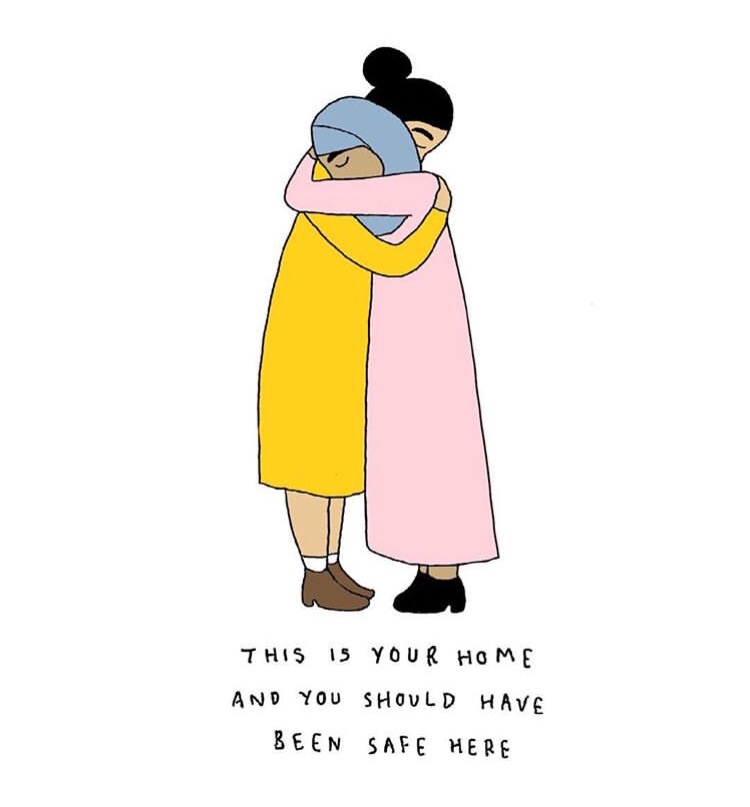
Artwork by Ruby Jones Instagram: @rubyalicerose
Whilst sitting in my MGNT102 lecture on Friday, I admittedly was having a quick scroll on Twitter when I came across the devastating news of the Christchurch terrorist attack. I sat in complete shock for the rest of the lecture, and that day. Today (Sunday), even as I write this, it still doesn’t seem real. 50 confirmed dead and many more injured in what can only be described as a horrific act of white supremacist terrorism. My heart goes out to the victims, their whanau and friends, New Zealand, and the Muslim community around the world.
Originally, I had planned to write this blog post about my experiences as a member of an audience to concerts and music festivals, but that simply did not feel right after what had taken place on Friday. The past few days have emphasised to me the major role media plays in tragic events like this, and how we, as an audience, influence it.
It has been hard to miss the constant bombardment of information seeping through our televisions, phones, computers, conversations and radios over the past 48 hours. It has contained floods of love and support for the Muslim community and victims, and heartbreaking news updates. It has also contained the complete opposite. Racist opinions and hate speech also leaked into our news and social media sites. The world, as an audience to the media, have watched on with intrigue and disgust.
From a national perspective, I was infuriated when Australian Senator Fraser Anning excused the terrorist act. I could go on for days about how predominant figures using their platform to spread xenophobic views are a major reason as to why attacks like Christchurch take place.
However, I was glad to see I was part of a majority of the media audience when (as of 4:21pm Sunday 17th March) over 856,000 people had signed a www.change.org petition titled, ‘Remove Fraser Anning from parliament’. Australia’s new “national treasure”, known as “Egg Boy”, also gave many people watching the media intently a reason to smile in a dark time as he cracked an egg over Senator Anning’s head during a live interview.
Overall, with the attack happening so close to home, and the way it has deeply affected such a large amount of people worldwide, it has highlighted to me the role in which we, as an audience of national and international media, impact the way in which news is shared. Our varying values and ethics as an audience influence our reactions to events, and what we decide to support or speak out against. We shape the media. It is our responsibility to take action against discrimination within it.
I would like to end this post with some words Osman Faruqi posted to his Twitter page in the wake of the Christchurch attack:
“ I feel so sad. We begged you to stop amplifying and normalising hatred and racism. But you told us we were ‘politically correct’ and ‘freedom of speech’ was more important. The more you gave the far-right a platform, the more powerful they got. We begged you.” – https://twitter.com/oz_f
Kia Kaha, Christchurch.
DISCLAIMER: I refuse to promote the agenda white supremacists try to spread through media, so certain names and information are missing from this blog post. I’m not sure this really counts as a disclaimer but I would just like to say that we as an audience to the media need to stop allowing racists to have a platform. We are all responsible. Speak up if you know something isn’t inclusive. If you excuse racism and xenophobia committed in any form, you are part of the problem. Any comments on this page featuring hate speech will be deleted.









 abbbey.home.blog